
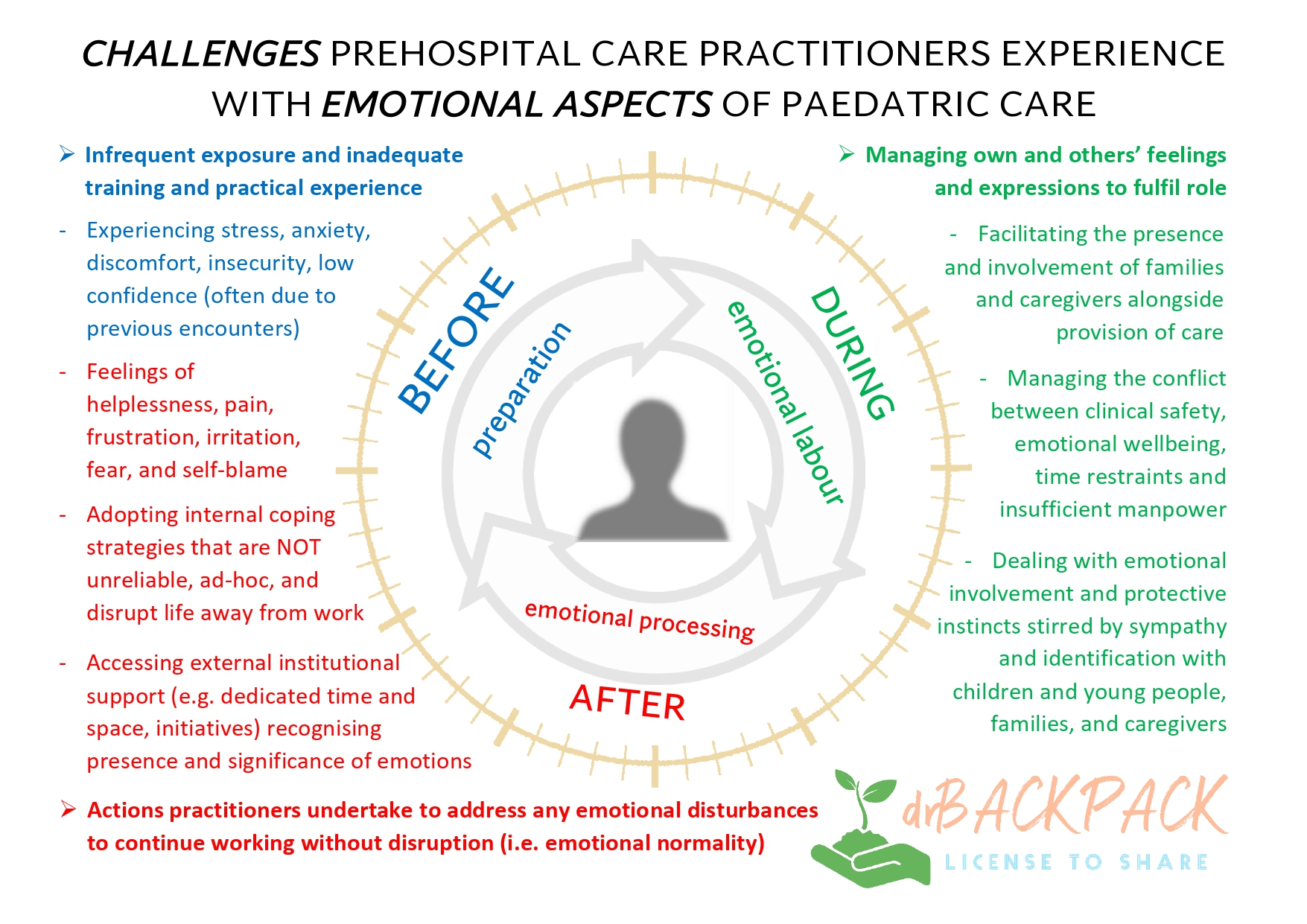
The first cardiac arrest I attended as a Student Paramedic in my first year was a paediatric cardiac arrest. The experience taught me much about myself, the colleagues I worked with, but more importantly, the sheer power and influence of emotions in healthcare. Why is it that children and young people stir such intense passion and emotion in practitioners? Why is there so much passion and emotion amongst families, carers, and those close to this demographic of people?
I’m not going to attempt to answer these questions right here, right now. I hope that the research I have done so far, and hopefully further research I can complete in the future, enables people to answer these questions themselves. In the meantime, I want to continue the journey I began with my article Where there is pain, there is love. I viewed that as the prologue to the literature review I completed for my dissertation to achieve my degree to qualify as a Paramedic.
Naturally, I’ve come to view my literature review as an accumulation of the experiences I had throughout my years as a Student Paramedic. I want to thus provide more detail to the context of this literature review before I share a link for you to access it.
Challenges in practice
Yes, my experience on the road thus pushed me to pursue academic answers to the challenges and dilemmas I encountered. During and after the paediatric cardiac arrest, it was difficult for me to fully analyse and evaluate what had occurred because I had nothing to compare it to. Guidelines, algorithms, flowcharts, and policies are important to follow, yet in such situations arguably fail to comprehensively address the queries such reflections stir. I thus held countless conversations with fellow practitioners in the aftermath, which I found enlightening yet simultaneously alarming.
Why? The behaviours and practice I witnessed from people was concerning, unsafe, unhealthy, staggering, mind-boggling. People had the potential to crumble with children and young people, and at times did, such was the intensity of passion and emotion surrounding them. Yet this was alarming because there was a reluctant informal awareness, understanding and appreciation of such issues and challenges, yet no formal acknowledgement and action taking place in paramedic practice, and more broadly, prehospital care, to address them. It upset me that people who cared and wanted to do the best they could were not necessarily in a position to do so and had to accept this as the way things were. That things could have been avoided and prevented, and this may have changed the outcome and effects upon ALL exposed and involved: it’s demoralising.
Challenges in training, research, and policy
The informal awareness I’ve alluded to has largely, and traditionally, led to dedicated efforts to increase training and learning around the clinical aspects of paediatric care, such is arguably the wider trend in prehospital care. In my view, prehospital care is essentially about optimising the scene and environment, and interactions between people, to enable medicine to take place, whatever the setting. Yet the medicine still takes significant precedence in our training, teaching and learning, the allocation of resources and academic attention.
As someone with an extensive background in social and political sciences, this precedence of the clinical aspects of prehospital care was overwhelmingly apparent and disappointing. The understanding and appreciation of the broad and intricate dynamics of human interaction, and of the role of space, place, and the environment, continues to be severely limited across prehospital care.
I thus decided to continue my background academic interest in children and young people and draw what I could from the social and political sciences towards prehospital paediatric care. Although this literature review holds great personal meaning to me, I believe it also the potential to be the beginning of significant and much needed change. If I was able to make a positive difference with what I’ve written, that would mean a huge deal more to me both personally and professionally. For now, I’m just grateful to be able to raise awareness of the dynamics at the focus of this literature review in the hope it can empower prehospital care practitioners, and the children, young people, families, and carers they may encounter.
Access
My literature review served as the dissertation for my degree in Paramedic Science (BSc Hons), and is titled ‘Challenges prehospital care practitioners experience with emotional aspects of paediatric care’. The DOI for this work is 10.13140/RG.2.2.18040.37120, and it can be access on ResearchGate by clicking on the following link: https://www.researchgate.net/publication/356189676_Challenges_prehospital_care_practitioners_experience_with_emotional_aspects_of_paediatric_care

 drBACKPACK